Last month I audited a supplement brand doing $2M a year on Amazon.
Premium positioning. Clean label. Real science behind the formulation. The kind of product a health-conscious buyer would naturally want to reorder every month for years.
Their Subscribe & Save enrollment rate was 6%.
Six percent.
Ninety-four percent of their revenue was strangers walking up, buying a single bottle, and vanishing into the void, most of them never to be seen again.
The founder was proud of the 6%. His exact words: "We turned it on last year. It's growing."
Then I pulled their S&S cohort data across the last seven months.
- Month 1: 997 active subscribers
- Month 2: 1,003
- Month 3: 1,008
- Month 4: 993
- Month 5: 1,001
- Month 6: 996
- Month 7: 1,004
Read that again.
They have been hovering at exactly 1,000 subscribers for seven months straight.
Their monthly churn rate was 6%.
Their monthly new enrollment rate was also 6%.
In other words: they had built a revolving door. Roughly 60 new subscribers walking in the front every month. Roughly 60 subscribers walking out the back. Zero compounding. Zero net growth. Just a thousand strangers cycling through the turnstile, each one paying them for two or three months before disappearing.
That's not a subscription business.
That's the illusion of a subscription business.
Every month, this founder looks at a subscriber count of "about 1,000" and tells himself he's building something. He isn't. He's running a treadmill that's been disguised as an escalator. The entire point of recurring revenue is compounding: customer two builds on customer one, month six builds on month one, the asset grows because retention keeps more than acquisition adds.
His asset isn't growing. It's perfectly static. For seven months.
Now here's the part that made my stomach drop.
I asked him what he was paying to acquire a customer on Meta.
"$64 on a good week. $81 on a bad one. Up from $47 two years ago."
He told me his agency was in the middle of a serious conversation about whether prospecting campaigns were still viable at current CPMs. He was sweating his DTC unit economics every single week.
Then I asked him what his Subscribe & Save discount was.
10%.
Ten percent off $85 is $8.50.
He was willing to hand Meta $64-$81 to acquire a DTC customer who would probably buy once and vanish because iOS 14 killed his retargeting window.
And he was offering one movie ticket, $8.50, to Amazon customers in exchange for a supposed lifetime subscription.
No wonder they were churning at 6% a month.
$8.50 isn't a reason to commit. It's barely a reason to notice.
The insight that changes everything
Here's what most brands are getting wrong about Subscribe & Save, and what the data from that $2M brand finally made me say out loud:
The discount isn't a price point. It's a commitment device.
When your S&S discount is good enough that the customer can't find a better deal anywhere on planet Earth (not on your Shopify site, not on one-time Amazon, not from a competitor at comparable quality), the customer stops shopping. They stop browsing. They stop asking whether they should switch brands next month. They are already getting the best deal they will ever find for the category, automatically, every month, without lifting a finger.
Where would they even go?
That is the psychological state you want your subscribers in. That is what retention actually is. Not a loyalty program. Not a brand affinity play. A simple, unambiguous, visible economic fact: "I cannot do better than this anywhere."
At 5% off, you're a rounding error. The customer is still shopping.
At 10% off, you're a nice-to-have. The customer is still comparing.
At 25-33% off, you are the floor price for this product on the internet. The customer stops shopping because the question has been answered.
That founder's 6% monthly churn isn't a pricing anomaly. It's a completely rational response from customers who correctly recognized that $8.50 off wasn't enough to make them stop looking for a better deal, so they kept looking, and eventually, they found one, and they left.
He could solve his entire retention problem in one decision.
He's not going to, because nobody on his team has made the case that trading first-order margin for retention lock-in is worth it.
Which is why his competitors will eat him alive in 24 months.
The CAC arbitrage hiding in plain sight
Let me show you the math nobody is doing.
Here are the current DTC customer acquisition costs as of April 2026, aggregated from MHI Growth Engine, Tenten, Varos, and my own client data:
- Pet products: $23
- Fashion: $37
- Beauty: $42
- Home goods: $45
- Food: $51
- Fitness: $67
- Supplements: $89
Supplements top the list. Premium supplement brands running Meta are routinely paying $92+ fully-loaded CAC on a good quarter. I personally know brands (Goode Health is one) where $92 is the best case. Hit a holiday quarter with degraded attribution and you're looking at $130+ per acquired customer.
Meta's Q1 2025 CPM hit an all-time high of $10.88, up 19.2% year-over-year. November 2025 peaked at $25.22. The average cost per purchase on Meta for DTC brands is up 19% YoY with conversion rates simultaneously dropping from 8.67% to 7.72%.
In other words: it costs more to reach fewer people who buy less often.
Now let's look at the other side of the equation, the side nobody is examining.
A premium VMS supplement sells for $84.99. The brand has a standard profitability target of ROAS 3, which is just the inverse of a 33% ACoS.
Every Amazon PPC manager in the world has run campaigns at 33% ACoS. It's not aggressive. It's baseline. Exploratory keyword campaigns routinely run 40-50% ACoS before they get optimized. Some brands push to 60% ACoS on high-intent competitor conquesting terms and call it "brand building."
33% ACoS on an $85 product = $28 per customer acquired.
Let that number land. The industry has already collectively agreed that $28 is an acceptable cost to acquire one single transaction from a customer who might never come back.
Now the question nobody is asking:
If we're willing to spend $28 in ad cost to acquire a one-time $85 buyer... why are we not willing to offer a $28 Subscribe & Save discount to acquire a recurring buyer?
Most brand managers hear "$28 discount" and their blood pressure spikes. "That's 33% off! We can't give away 33%!"
But they will happily sign off on a 33% ACoS Sponsored Products campaign, to acquire a customer who shows up once.
Same $28.
Radically different outcome.
The $28 ACoS buys you a single transaction. The $28 S&S discount buys you a subscription. A subscription where you pay the $28 once at enrollment and then keep getting paid month after month, and, critically, a subscription where the discount is steep enough that the customer stops shopping. They are no longer comparing prices. They are no longer a potential conversion for a competitor. They are yours until they actually stop using the product.
Industry data (Red Stag, Dose case study, Envision Horizons cohorts) shows Subscribe & Save subscribers deliver 20-51% higher LTV than one-time buyers. But that data was collected on brands running 5-10% discounts. The brands running genuinely compelling discounts (the kind that trigger the "where would I even go?" psychological lock) are seeing multi-year retention curves that make those numbers look conservative.
Run the numbers on 6 months at $85/bottle: $510 in gross revenue per subscriber.
Your $28 S&S discount (paid once) becomes the equivalent of a $5 blended CAC across the subscription lifetime.
Your Meta team is paying fifteen to eighteen times that for demonstrably worse customers.
This is the single most under-exploited arbitrage in e-commerce right now.
Why nobody has framed it this way
I have read every major S&S playbook published in the last 18 months. Pattern, BellaVix, Envision Horizons, beBOLD, PDMG, Titan Network, every agency blog on the subject.
They all cover the mechanics. Discount tiers. Funding structures. Coupon stacking. Churn monitoring. Inventory stability. They're useful posts.
But not a single one of them has framed Subscribe & Save as what it actually is:
The cheapest subscription customer acquisition channel in e-commerce, and the most powerful commitment device a brand can deploy on Amazon.
On Meta, you pay your CAC upfront, you eat the attribution loss from ATT, you pray the customer comes back to your Shopify site without another paid click, and you build email/SMS flows to try to create retention your paid channel can't.
On Amazon S&S, you pay your "CAC" as a discount baked into the product price. The customer is already on Amazon. They are already searching. They are already in buying mode. You are not paying to create demand; you are paying to convert intent into subscription, AND to make that subscription sticky enough that the customer stops shopping around.
The economics are not comparable.
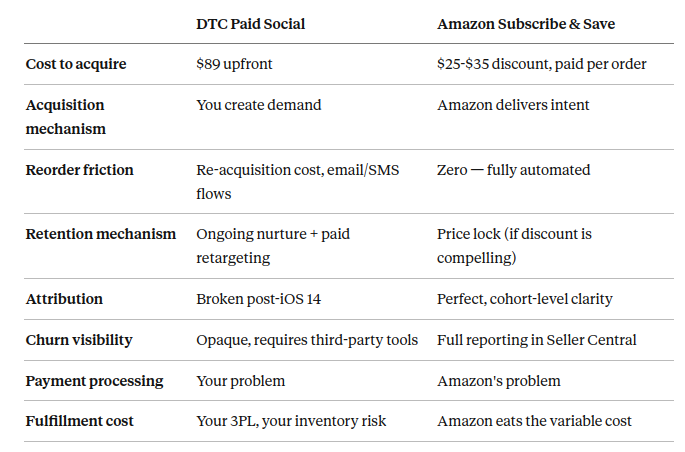
And here is the piece nobody talks about: the S&S discount isn't even fully yours to fund.
Amazon co-funds an additional 5% when a customer hits the 5-item tier (which Amazon's algorithm is aggressively nudging buyers toward by default). So a brand funding a 10% base discount actually delivers 15% to the customer, and Amazon picks up a third of the bill.
Amazon wants Subscribe & Save to grow. It stabilizes their fulfillment forecasting, reduces their variable handling costs, and locks customers into the Amazon ecosystem. They are literally subsidizing your retention program.
And if you're a 1P vendor, you can go much further than that. I'll get to it in a minute.
The brands getting this right are eating everyone's lunch
Puracy (the Austin-based cleaning and personal care brand) has quietly grown Subscribe & Save to 35% of their annual revenue over seven years. They didn't do it by having better ads. They did it by treating S&S as the product, not the afterthought.
Dose Wellness tested their way to a 10% funded discount structure (with Amazon's 5% co-fund bringing customers to 15%) and built a profitable subscription channel on Amazon that complemented rather than cannibalized DTC. They reported 51% higher LTV on S&S customers versus one-time buyers, with reorder rates doubling after optimization.
Meanwhile, here is what I see in 90% of audits:
- S&S is sitting at 0%, 5%, or 10%, treated as "nice to have"
- Enrollment rate is under 10% of total orders
- Churn equals new enrollment (the revolving door)
- Nobody owns it; it's an orphan between the PPC manager and the brand manager
- Listing content doesn't promote the subscription: no A+ module, no lifestyle imagery, no "never run out" messaging
- The S&S Performance Report hasn't been opened in 90 days
- Churn by SKU is a black box
- First-time S&S coupons aren't being deployed
The result: a $50M brand leaving $8-15M in recurring revenue on the table, every single year, because nobody on the team has the authority, the framework, or the incentive to own the subscription line item.
The 1P play nobody is making: getting Amazon to co-fund your S&S discount
Here's something that applies specifically to 1P vendors, and if you're sitting at 21st Century HealthCare, Edgewell, Unilever, P&G, or any multi-brand vendor with meaningful AVN leverage, this is the section that pays for this entire article ten times over.
Amazon will co-fund your Subscribe & Save discount. You just have to negotiate it during AVN.
Most 1P brand managers don't know this is negotiable. They see the S&S funding tier line item in their vendor agreement, they accept Amazon's "standard" 10% seller-funded ask, and it comes straight off their margin at the vendor cost level. No questions asked.
Sharp vendor negotiators know four different levers on this:
1. Carve S&S funding out of your existing co-op accrual
Every 1P vendor funds a co-op budget (often 3-8% of revenue). That budget is earmarked for promotional activities. Most vendor managers let Amazon unilaterally allocate it: some goes to Prime Day, some to Lightning Deals, some to the vendor-facing co-op promotions. S&S seller-funded discounts can be pulled from that pool rather than funded as incremental margin compression. If you're already funding 5% of revenue in co-op and Amazon is asking for an additional 10% S&S fund, you just doubled your promotional cost. Refuse the incremental. Allocate from the existing pool. That's a direct margin recovery.
2. Negotiate tiered funding by SKU
Hero SKUs with inelastic demand (your bestsellers where customers will buy regardless) shouldn't need a deep S&S discount to drive enrollment. Your long-tail SKUs that need the velocity boost should get the heavier funding. Most vendors accept Amazon's "flat 10% across the portfolio" ask. Smart vendors negotiate 5% on hero SKUs, 15% on growth SKUs, average out at 10%. The math works out the same on paper, but you've preserved margin where it matters and put discount dollars where they'll actually drive enrollment lift.
3. Ask Amazon to match your S&S fund with equivalent co-op pull
This is the power move. When you're negotiating a higher seller-funded S&S rate (say, 15%) on a growth initiative, ask Amazon to match with equivalent promotional support on your behalf: incremental Coupon placement, Subscribe & Save Coupon slots, Prime Day inclusion, Brand Store feature boxes. Amazon has promotional inventory they're already monetizing. If you're committing real S&S funding that drives their subscriber growth (which their internal teams are literally measured on), they have incentive to match your commitment with inventory that would otherwise cost you tens of thousands of dollars in ad spend.
4. Pan-European and multi-marketplace coordination
If you're a multi-country brand, and for 21st Century (50+ countries) or Edgewell (operations in 50+ countries with distinct brands like Wilkinson Sword as Schick's European identity) this is extremely material, negotiate S&S funding once across marketplaces rather than separately in each country. The Pan-European S&S setup allows unified discount funding across five EU marketplaces. Most US brands don't think to negotiate this. They negotiate country by country with different vendor managers, and the discount rates drift all over the place. Negotiate the framework once, apply globally, and suddenly your international S&S program has consistent economics instead of five separate conversations.
I have seen seven-figure brands save $400K+ annually by restructuring how their S&S funding flows through AVN. I have seen nine-figure brands unlock eight-figure co-op reallocations by treating S&S as a negotiating chip rather than a fixed cost line.
If you are a 1P vendor reading this and your next AVN is in the next 180 days, this is the highest-leverage conversation in the entire negotiation. Most brand managers won't raise it because they don't know it's negotiable. Your vendor manager won't bring it up because every dollar they can get you to fund directly is a dollar they don't have to match from the co-op pool.
Ask. Specifically. In writing.
What the category leaders are actually doing in April 2026
Let me pull back the curtain on the playbook that works right now.
1. Fund the discount like it's CAC replacement, not a coupon
Most brands anchor their thinking at 0-10%. Wrong frame. The question to ask is: "What discount level would make our S&S the best price this customer can find anywhere on the internet for this product?"
For premium supplement brands with $70-$120 price points, that answer is usually 20-30% seller-funded. With Amazon's 5% co-fund at the 5-item tier, the customer sees 25-35% off. That's not a discount. That's a commitment device. The customer sees it and stops shopping.
Yes, that's deeper than any playbook I've seen recommend publicly. The playbooks I've read all say "start at 5%, test up to 10%, maybe 15% on hero SKUs." That advice is calibrated for brands trying to minimize margin compression. If your goal is to minimize margin compression, congratulations: you will also minimize subscriber acquisition and retention, and your competitor who made the bigger bet will own your category in 18 months.
The playbook most agencies publish is safe. Safe is not how you build a moat.
2. Deploy first-time S&S coupons as the on-ramp
A $5-$10 first-delivery coupon stacked on top of the base discount converts fence-sitters at 3-5x the rate of the base offer alone. The first order discount is deeper, enrollment friction drops, Amazon's algorithm sees higher S&S adoption, the listing gets rewarded with better organic placement.
Cost to you: one coupon hit on order one. Benefit: a subscriber who, if retained past the second refill, pays that coupon back 10x over the lifetime.
3. Rebuild your listing around the subscription
Most A+ Content treats S&S like a checkbox. The brands winning are dedicating an entire A+ module to "Why subscribe": auto-delivery, never run out, lock in today's price, skip or cancel anytime. The imagery shows the product fitting into a daily routine, not just a feature list.
A razor cartridge brand I won't name (but you know which one, the one that sells 6-week replacement cycles) could absolutely dominate Subscribe & Save in their category if they positioned the cartridge as "never think about shaving supplies again." They don't. They promote the starter kit and leave the subscription language buried in the fine print.
A cleaning wipes brand (same hint) has one of the most naturally S&S-perfect products on Amazon: you use them up, you need more, the cycle is predictable. Their S&S enrollment should be 40%+. I'd bet serious money it's under 15%.
A daily multivitamin brand (one capsule every morning, 60 capsules per bottle, 60-day natural cycle) should be running S&S as 50%+ of total revenue. Most are running it at 8%, with 6% churn, on a 10% discount.
4. Optimize frequency for the 5-item tier
Amazon's algorithm actively nudges customers toward a 3-month interval even on products with a 30-day supply, because at 3 months, customers can stack their deliveries with other subscriptions and hit the 5-item threshold for Amazon's 5% co-funded discount.
Brands fighting this mechanic are losing margin. Brands leveraging it are winning. If your product is a daily supplement taken once per morning, don't fight for a 30-day subscription. Offer a 90-day supply SKU at a volume price, let Amazon's algorithm suggest 3-month intervals, and ride the 5-item discount wave into dramatically higher retention.
5. Treat churn data like a signal, not a scoreboard
This is the one that would have caught the $2M founder's problem months earlier.
The S&S Performance Report in Seller Central shows:
- Net subscriber count by month. If this number is flat for more than 3 months, you are running a revolving door. Flat is not stable. Flat is losing, because every month your CAC climbs on the DTC side and your competitors lock in another cohort.
- Cancellation rate by SKU. If one SKU churns at 60% and another at 15%, the 60% churner has a product problem, not a pricing problem.
- Average subscription length. This is your LTV denominator. If you don't know this number, you cannot build a subscription business.
- Out-of-stock rate. Stockouts don't just pause deliveries; they cancel them permanently. A 2-day stockout can nuke 10% of your subscriber base. Permanently.
- Discount elasticity. Did your 10% to 15% test actually lift enrollment AND cut churn? Or did it just compress margin on existing subscribers? The right answer is both (enrollment up, churn down), and if only one of those happened, you didn't go deep enough.
If your team can't produce this data in a 15-minute meeting, nobody on your team is actually running the subscription business. It is running itself. And it is running downhill.
6. Negotiate Subscribe & Save terms during AVN
See the extended section above. This is the single highest-leverage 1P play most vendors never make.
7. Stop treating S&S and PPC as separate worlds
Repeat-buy intent keywords ("refill," "daily," "monthly supply," "replenishment," "subscribe") attract customers who are pre-qualified for subscription behavior. Running Sponsored Products on these terms and routing to a listing optimized for S&S enrollment is cheaper, more effective acquisition than hunting broad category terms.
Traditional ROAS reporting will make these campaigns look mediocre. Customer converted at $85, ACoS was 35%. PPC manager gets flagged in Monday review.
But if 40% of those customers enrolled in S&S at a 25% discount they can't find anywhere else, and the average subscription runs 6+ months because the offer is strong enough to stop the shopping behavior, your subscription-adjusted ACoS across the subscription lifetime is closer to 6%.
Your PPC team should be evaluated on subscription-adjusted ROAS, not first-purchase ROAS. Most aren't. That's a tooling problem and a reporting problem, and it's why the brands who figure out LTV-aware ad bidding will own their categories over the next 24 months.
The international layer
Subscribe & Save operates in every major Amazon marketplace: US, UK, Germany, Japan, India, Mexico, and beyond. The Pan-European S&S setup lets you run coordinated subscription offers across five marketplaces simultaneously if you've negotiated the vendor terms correctly.
Most US brands don't even think about this. They'll launch in Germany, set S&S at 0%, and wonder why the international business grows slowly. For brands selling in 50+ countries, the S&S opportunity in international markets is often larger than the US opportunity because competition is still immature.
I'll go deeper on international expansion in the next piece.
The conversation to have Monday morning
Walk into your next leadership meeting and ask these questions:
-
What is our S&S net subscriber count, month-over-month, for the last 12 months? If the line is flat, you are running a revolving door.
-
What is our monthly churn rate, and what is our monthly new enrollment rate? If they are the same number, you have no subscription business; you have a subscription illusion.
-
What is our seller-funded S&S discount by SKU, and when did we last test it against a genuinely aggressive rate (20%+)? If the answer is "we haven't," you have millions of dollars of recurring revenue sitting unbuilt on the table.
-
For 1P teams: what portion of our S&S funding is being pulled from existing co-op vs. funded as incremental margin compression? If nobody on the team can answer that, you just found six or seven figures of recovered margin in your next AVN.
-
What would our business look like in 12 months if 30% of our revenue was recurring with a compounding subscriber count, versus the current flat line? Do the model. The answer will terrify you.
If your team cannot answer those five questions (and in my experience, 90% cannot), you have a subscription business buried inside your existing Amazon account that is not being built. It's just sitting there, cycling through strangers, pretending to grow.
And every month you leave it cycling, your CAC keeps climbing on the DTC side, your competitors keep locking in the subscribers whose loyalty you failed to buy, and your moat gets shallower.
The uncomfortable truth
Your DTC team is paying $40-$90 to acquire single-transaction customers.
Your Amazon team is offering $4-$8 off to "recurring" customers who are actually churning out the back door as fast as they come in.
The math is screaming at you.
The brands that will win on Amazon in the next 24 months are not the ones with the lowest ACoS or the best PPC agency. They are the ones with the highest Subscribe & Save enrollment rates AND the lowest churn, because recurring revenue only compounds when customers actually stay.
And customers only actually stay when the deal is genuinely better than anywhere else they can find.
One-and-done sucks. The appearance of recurring, which is actually one-and-done-in-disguise, is worse, because it hides the problem while the problem compounds.
And here's the last thing worth saying, as bluntly as I can: this isn't complicated. The framework is not hard. The reporting exists inside Seller Central. The levers are all accessible. There is no technical barrier to running a 30%+ S&S enrollment rate at a 2% monthly churn on hero SKUs in a category where the product naturally replenishes.
The only barrier is that nobody on the team is building it, because nobody on the team has been given the mandate, the framework, or the cover to trade short-term margin for long-term compounding retention, and for 1P teams, nobody has made the AVN case to get Amazon to co-fund the bet.
Somebody has to make that call. Somebody has to say: "We're funding an S&S discount deep enough that customers stop shopping. We're rebuilding the listing around the subscription. We're negotiating our AVN to get Amazon to co-fund a meaningful portion. We're going to accept 3-6 months of margin compression to build a retention asset that pays us for the next five years."
That call doesn't get made at the brand manager level. It gets made at the VP, CEO, and CFO level. And it usually gets made after someone frames the decision correctly.
Which, incidentally, is most of what I do.
Dan Matejsek is the founder of RavingFans.ai and creator of PerfectASIN. 27 years of e-commerce experience. $572M in career online revenue. He currently consults with Amazon brands on listing optimization, advertising strategy, and AI-powered growth.
Consulting inquiries: ravingfans.ai · All articles: ravingfans.ai/blog