Those savings get entered into the "Pure Profit" column on the P&L, by the way.
Who's This For?
Ideal Reader Profile: A manufacturer of small Consumer Packaged Goods or Fast Moving Consumer Packaged Goods. Think Food (Freeze Dried Candy, anyone?), Beauty, Personal Care, Nutritional Supplements, etc.
Or Marketing Professionals who oversee Amazon Channel Managers or Agency Partners. CEOs, CMOs, COOs, and even CFOs.
You can use this to create savings in your logistics for Amazon or even how you handle your wholesale distributors' orders for your Brand.com site.
Amazon FBA Tweak #1: Convert SKUs to Use UPCs Instead of FNSKU Stickers
Yes, this sounds silly to some of you; this brand was having their 3PL provider put white FNSKU stickers over their UPC labels. $0.50 per unit plus labor (I didn't even factor that into the numbers above).
Why would they do that?
Because they had a Boutique Amazon Agency running their Amazon Business for them, and they are idiots who either didn't know better or didn't care.
The Fix
Amazon creates a new SKU for your existing SKU and they append a hyphen and the word "stickerless" to the SKU. (See image below on the far left.)
Total savings from not having to pay the 3PL or Amazon to sticker the units: $0.50 per unit.
This shipment total savings = 1,440 x $0.50 = $720

Amazon FBA Tweak #2: Maximize Master Case Size (Up to 50 lbs)
This is another no-brainer fix. How many bottles of pills did they have in the Master Case size?
- Yep.
Why?
Because sometimes clients like to buy them by the dozen from the Brand.com website and no one thought (Agency again) that this was a silly idea when we ship 1,440 units to Amazon FBA. So, their Agency was actually directing them to stack 120 x 12-unit cases on a Pallet and shipping them to Amazon.
The Fix
I had the 3PL rework it to get the bottles into a larger case. Only instruction: How many bottles can you fit into a box and keep the weight below 50 lbs?
50 lbs is the maximum allowed for multi-unit cases because that is UPS' maximum.
Side note: For oversized units, if only 1 unit will fit into a box, the max is 70 lbs.
Answer: 120 bottles is our new Master Case Quantity, in a larger box.
Amazon FBA Tweak #3: Ship Using Small Parcel Delivery Instead of LTL (Pallets)
Less Than Truckload is LTL, and that is what the industry calls a pallet. Your pallet, along with other people's pallets, shares 1 truck to make a load. Sure, you get to send all of your stuff in 1 shipment to Amazon. Easy for you, right?
Well, there are many reasons not to do this.
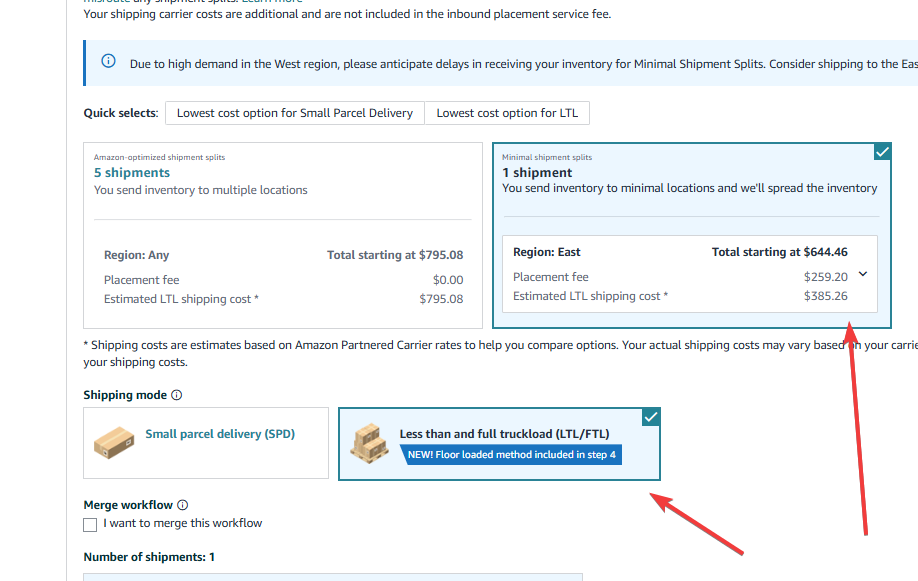
If you can avoid this (LTL) method, do so. There are several reasons why.
The Problems with LTL
LTL arrives on a truck and quite often sits in a freight yard at Amazon waiting for weeks to get checked in. The shipment before this last one, where I saved them money, sat for 5 weeks in a trailer in 85-90°F heat in Homestead, FL. This is not good for vitamins that are sensitive to heat.
Once the LTL shipment finally gets checked in, it then gets redirected to the Fulfillment Centers around the country. Yet more time (3-4 weeks more) and possibly more exposure to heat for sensitive cargo. The shipment in question, before the savings shipment, was shipped to 76 different FC locations after it was checked in.
LTL Shipments of 1 shipment have placement fees, $259.20 in the above example. It wouldn't make sense to ship 5 separate LTLs due to cost and not enough product for a pallet.
Yes, I know there was a big stink about Placement Fees from sellers on social media about "yet another way Amazon is screwing sellers!" It's total BS. Amazon is simply having Sellers pay for all of this shipping to distribute the product around the country. We sellers had this for free before placement fees. Now, Amazon is having us pay for that convenience, and rightfully so.
Why Small Parcel Wins
Amazon Small Parcel Delivery (UPS) gets delivered inside the Distribution Center and gets to skip the long line of waiting to get checked in. You literally can have items shipping within days of delivery. No heat worries, no waiting, and saves 9 weeks (above example) of lag time between when you ship to Amazon and it gets into the hands of customers.
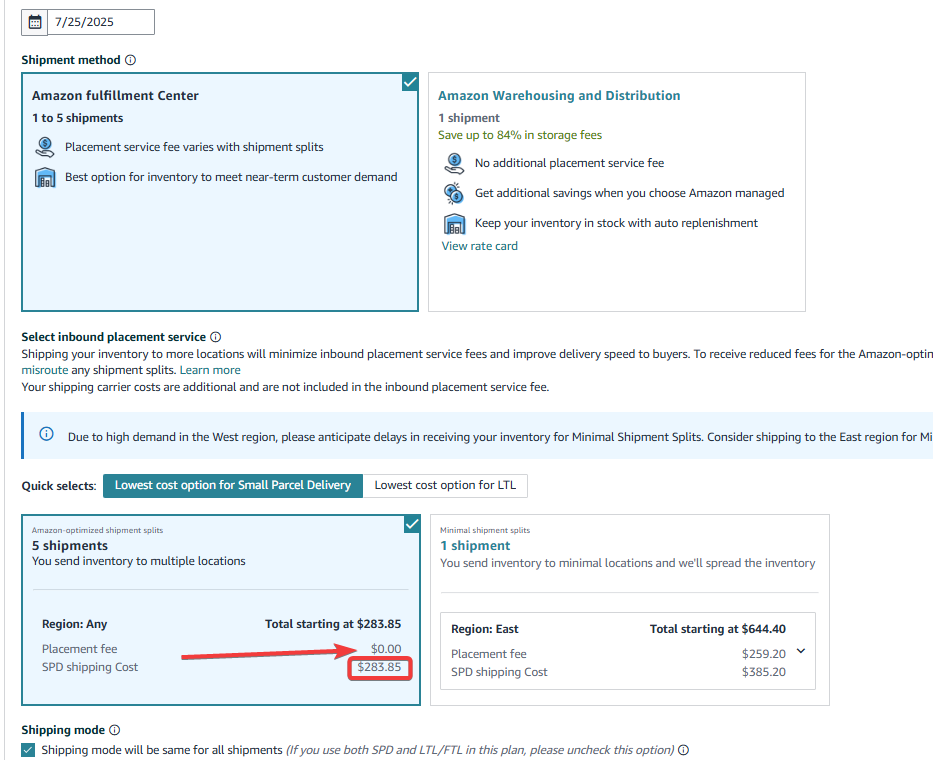
You would think that it would be more expensive to ship 12 cases to 5 different locations.
Nope. It's $101.35 less expensive than the 1 LTL.
Total savings on shipping & placement fees = $360.55
PRO TIP: This is kind of a cheat when launching new brands in Fast Moving Consumer Packaged Goods niches. Amazon gives priority to geographically available stock. If you play the game fast, they do reward you by selling a crap ton of your product (even if you are new to the niche).
This is exactly how I dominated 5 categories in the Freeze Dried Candy Niche within 6 months' time with a brand new candy brand.
The Sustained Savings Playbook
So, the secret to sustained savings and extra profits left over is to always, from now on:
- Always use stickerless SKUs so you don't need to pay for FNSKU stickers.
- Ship large quantities of units to capitalize on Amazon's multiple shipments option to Distribution Centers.
PRO TIP: Target shipping 60 days of inventory and multiple SKUs if you have to get a large shipment. Make sure it is enough units that Amazon will break it up into 5 different shipments. Why? They will waive placement fees.
The Bottom Line
- Total savings this shipment for 1 SKU: $1,080.55
- Total yearly savings: 13,058 Units x $0.75 per unit ($1,080.55 / 1,440) = $9,798.49
That's pure margin. No revenue increase required. Just stop doing dumb things with your logistics.
Dan Matejsek is the founder of RavingFans.ai and creator of PerfectASIN. 27 years of e-commerce experience. $572M in career online revenue. He currently consults with Amazon brands on listing optimization, advertising strategy, and AI-powered growth.
Consulting inquiries: ravingfans.ai · All articles: ravingfans.ai/blog